Posts

SPRAY FOAM FOR THE BUILDING ENVELOPE

Image
SPRAY FOAM FOR THE BUILDING ENVELOPE BUILDING ENVELOP BUILDING ENVELOPE IN TEXAS. The temperature inside a building, the moisture coming into and out of the building, and the movement of air is all controlled by a system of design components and construction materials known as the building envelope. In order to achieve a more healthy, comfortable and stable indoor climate, the building's insulation, as well as the moisture and air barrier, need to work together. To extend the sustainable service life of commercial and residential buildings, new design practices and materials are continually being brought to the forefront. Compact Construction, Proper Ventilation It is both customary and code-compliant in home and building design to ventilate crawl spaces and the attic. The reason for these spaces needing ventilation is to address issues such as condensation, heat transfer, and the results of "stack-effect issues," which building design practices and st...

WHAT ARE THE DIFFERENT TYPES OF SPRAY FOAM?

Image
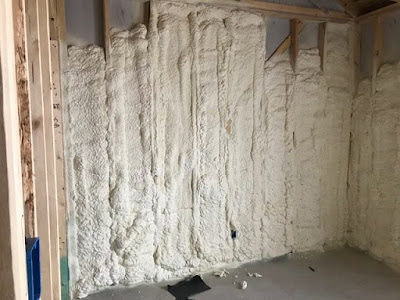
CLOSED-CELL SPF Closed-Cell Spray Foam Insulation can serve  as a five-in-one application by providing  exterior insulation, an air barrier,  a vapor retarder,  a drain plane,  and a water-resistive barrier  in a single application. _________________________________________________________________________________ OPEN-CELL SPF Open-Cell Spray Foam Insulation is intended as cavity insulation inside exterior and interior walls, and for use in attics and crawlspaces. CLOSED-CELL  VS.  OPEN-CELL  FOAM If your aim is to learn about spray polyurethane foam insulation, you're on the right page. Before going forward with a spray foam application on either a commercial or residential building, it is important to establish whether you will utilize .05 lb./cu. ft., open-cell foam or 2.0 lb./cu. ft. closed-cell foam. When factoring performance, the method of application and price, the differences between the two are sign...
Image
HOW DOES FOAM STRENGTHEN HOMES?  The main component which gives structure to your home is the walls. In wood frame construction, the weight of the roof, shingles, Standing rain water, the weight of the roof, snow, and shingles all add weight to the roof on wood construction, which results in a compressive force to the walls from exerting downward forces.  Workshop-Roof Line Only (closed cell) Imposing lateral forces on the walls of the homes are created from gusts and high winds from storms. A "shearing force" can be generated by the lateral forces that distort the walls. To be able to withstand these forces and loads, a home's walls are required by building codes to be designed in a certain way. Walls are nevertheless sometimes built to the minimum standards, so sounds of creaking and shaking that are created through movement or during high winds can often be heard.  Workshop-Roof Line Only (closed cell) To reinforce both the studs and the exterior sh...